TL;DR: Why does my puppy bite so much? Puppies explore the world with their mouths, and between 8 weeks and 6 months biting is driven by teething pain, play, and learning bite inhibition — how to control jaw pressure. Sharp but brief mouthing that redirects to a toy is normal. Biting with a stiff body and hard stare, or biting that draws blood, needs a trainer's help.
Key takeaways
- Puppy biting is normal development: puppies explore with their mouths and teethe until about six months.
- Play biting teaches bite inhibition — jaw control a dog needs for the rest of its life.
- Overtired and overstimulated puppies bite hardest; many "crazy biting" evenings are a nap problem.
- Growling with a stiff body, guarding food or toys, or bites that break skin call for professional help.
New puppy owners are rarely warned how much biting is coming. Between eight weeks and six months, a normal, friendly puppy will chomp hands, ankles, sleeves, and shoelaces with teeth like needles, and it can feel like you brought home a small alligator instead of a dog.
Nearly all of it is normal development rather than aggression. Knowing why the biting happens — teething, play, and learning to control that jaw — tells you how to respond, how to protect kids in the house, and how to spot the rare puppy whose biting is a genuine warning sign.
Track the biting instead of just surviving it
PetStory lets you log when your puppy bites hardest, what happened just before, and how long since the last nap. A week of notes usually reveals the pattern — teething, overtiredness, or a specific trigger — so you can fix the cause instead of the symptom.
Related reading
- How to stop a dog from jumping on people - Part of the dog training, body signals, and daily health guide cluster.
- why does my dog lick his paws? - Part of the dog training, body signals, and daily health guide cluster.
- Why does my dog lick the floor? - Part of the dog training, body signals, and daily health guide cluster.
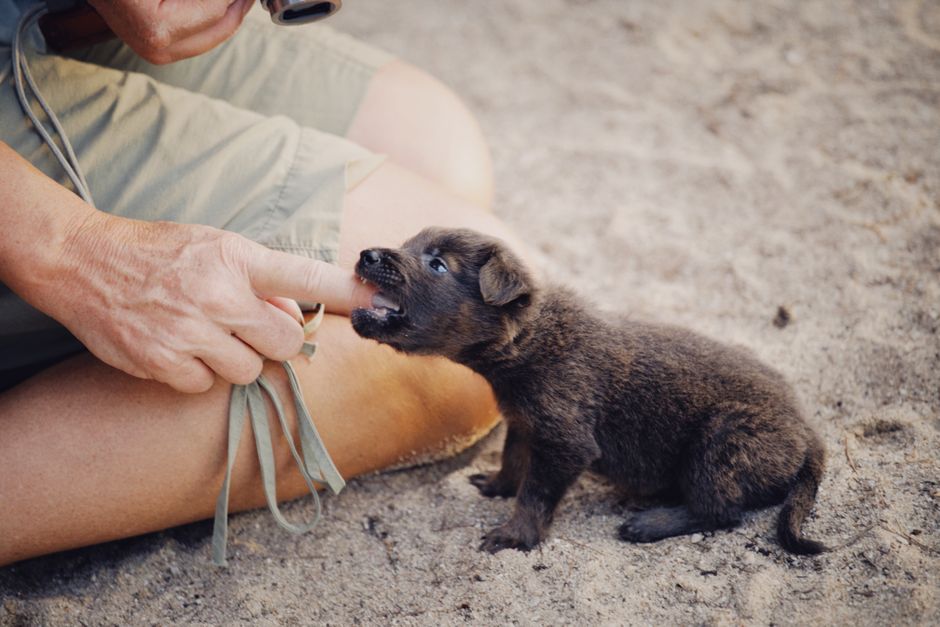
Why does my puppy bite so much? The short answer
Direct answer: Puppies bite so much because mouths are how they explore, play, and relieve teething pain, which runs until about six months. Biting is also how a puppy learns bite inhibition — controlling jaw pressure. Playful mouthing with a loose, wiggly body is normal. Biting with a stiff body, hard stare, or guarding is the kind that needs help.
Puppies have no hands, so everything interesting goes in the mouth: your fingers, the leash, the rug fringe. Layer on sore gums from teething and the wrestling style puppies use with littermates, and heavy biting between 8 and 16 weeks is not a flaw in your puppy — it is the factory setting. The ASPCA guide to mouthing and nipping draws the same core line trainers do: playful mouthing is normal, and the goal is teaching gentleness, not punishing the mouth.
The good news is that this phase is where a dog learns its most important lifelong skill: bite inhibition. A puppy that learns now that teeth on skin ends the fun grows into an adult that pulls its punches even when startled. The causes below cover the three big drivers and what to do about each.
Action checklist
- Mouths are a puppy's hands: exploration, play, and teething all go through them.
- The heavy-biting window runs from about 8 weeks to 6 months.
- Normal play biting comes with a loose, bouncy, wiggly body.
- Stiff posture, hard stares, or guarding turn biting into a red flag.
Practical takeaway
Puppy biting is the default, not a defect — your job is to shape it, not eliminate it overnight.
Cause 1: Teething makes puppy biting peak
Puppies cut 28 baby teeth in their first weeks, then lose them all as 42 adult teeth push through between roughly 12 weeks and 6 months. Gums ache through much of that stretch, and chewing gives real relief — which is why the biting often spikes just when you hoped it would fade, around four to five months. You may find tiny shed teeth on the floor or small blood spots on toys; both are normal.
Give the mouth legal targets. Keep several textures in rotation — rubber chew toys, a rope, a soft toy — and offer one the moment teeth land on skin, so the puppy learns what is always allowed. A wet washcloth twisted and frozen, or a stuffable rubber toy from the freezer, numbs sore gums better than anything else in the house. What lands on your hands should always be redirected, calmly and consistently, to a toy.
Action checklist
- Teething runs until about six months, with a peak around four to five months.
- Frozen washcloths and freezer-chilled rubber toys soothe aching gums.
- Rotate chew textures so a legal option always beats your hands.
- Finding shed baby teeth or tiny blood spots on toys is normal.
Practical takeaway
A teething puppy must chew something — your only choice is whether it is a toy or your hand.
Cause 2: Play biting and learning bite inhibition
Watch two puppies wrestle and you will see constant mouthing — until one bites too hard, the other yelps and quits, and play stops. That feedback loop teaches bite inhibition, and when your puppy left the litter, you inherited the teaching job. A puppy that mouths your hand in play is not being dominant or mean; it is playing the only game it knows with the only littermates it has left.
Teach it the same way a littermate would. The instant teeth hurt, mark it with a calm "ouch," stop all play, and go still or step away for ten seconds — the fun ending is the lesson. Then return and offer a toy. Avoid punishments and avoid roughhousing with bare hands, which teaches the opposite lesson. With children in the house, make the rule symmetrical: kids never play hand-wrestling games, and the puppy gets a calm crate break when arousal climbs. A structured training app can help everyone in the family apply the same rules the same way.
Action checklist
- Mouthing in play is how puppies play — your hand replaced a littermate.
- Teeth on skin ends the game: brief, boring, consistent timeouts teach fastest.
- Never hand-wrestle a mouthy puppy; always finish by redirecting to a toy.
- Give kids a script: stand still, arms folded, and let an adult redirect the puppy.
Practical takeaway
Bite inhibition is taught by consequences, and the consequence that works is the fun stopping.
Cause 3: Overtired, overstimulated, or under-exercised
Ask any trainer about the nightly "witching hour" — the frantic sprint-and-chomp meltdown around dinner time — and they will ask when the puppy last napped. Puppies need 18 to 20 hours of sleep a day, and an overtired puppy loses all bite control, exactly like an overtired toddler. Those wild evening bursts are close relatives of the zoomies, and the hard, relentless biting that comes with them is fatigue, not defiance.
The counterintuitive fix is enforced rest: a calm crate or pen nap after every hour or so of activity, especially before the usual meltdown window. Boredom drives the opposite version — a under-exercised puppy with no outlet invents ankle attacks — so balance the day with sniffing walks appropriate to age, short training games, and food puzzles. If the biting comes with clinginess and panic when you leave, read up on signs of anxiety in dogs, because anxious arousal also comes out through the mouth.
Action checklist
- Puppies need 18–20 hours of sleep; overtiredness switches off bite control.
- The evening "witching hour" is usually a missed-nap problem.
- Enforce crate or pen naps after every hour of activity.
- Balance rest with sniff walks, training games, and food puzzles.
Practical takeaway
The hardest-biting puppy in the room is usually the one that most needs a nap.
When puppy biting needs a trainer or a vet
Normal puppy biting, even when it hurts, comes wrapped in loose, wiggly body language and redirects to a toy within a few tries. Get professional help when the picture differs: biting with a stiff body, hard stare, or deep growl; snapping when you reach for food, toys, or resting spots; bites that puncture skin; or a puppy that cannot be interrupted at all and escalates when you disengage. Those patterns respond best to a certified trainer or veterinary behaviorist now, while the dog is small and habits are soft.
Loop in your vet, too, if biting spikes suddenly alongside other changes — refusing food, drooling, pawing at the mouth — since dental pain, retained baby teeth, and mouth injuries all make a puppy bitier. And set expectations honestly: mouthing fades gradually as teething ends near six months and training compounds, not in a single breakthrough week. Consistency from every human in the house is what finishes it.
Action checklist
- Stiff body, hard stare, growling, or guarding: book a certified trainer.
- Bites that puncture skin are beyond normal play at any age.
- A sudden biting spike with drooling or food refusal: check the mouth at the vet.
- Normal mouthing fades near six months as teething ends and training sticks.
Practical takeaway
Wiggly biting is a phase; stiff, guarding, or skin-breaking biting is a professional's case.